The AI that tells you what
your business is worth —
and how to make it worth more.
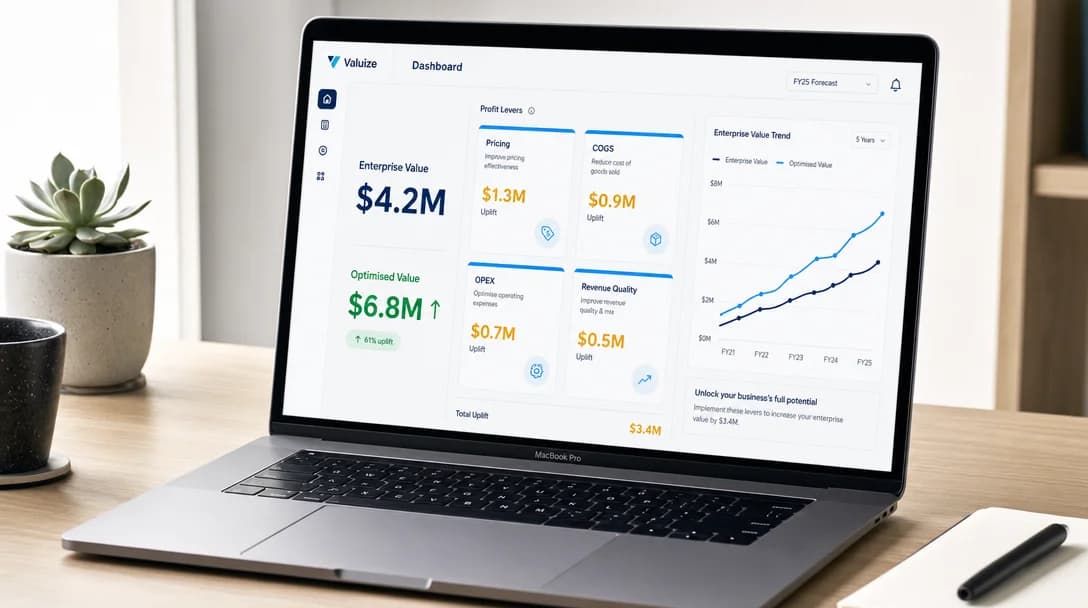
APVAS calculates your enterprise value using industry-calibrated EBITDA multiples, surfaces your top profit levers with dollar amounts attached, and generates an AI execution plan. Then it does it again next month.
20 min
to your first enterprise value
4
AI-ranked profit levers
3×
scenario bands (conservative → aggressive)
12 mo
of profit trend tracking
Three AI layers working for you
Not a chatbot. Not a dashboard that just shows numbers. APVAS uses GPT-5.5 at three specific moments where AI actually changes what you do next.
AI Onboarding Guide
5-step wizard walks you through your first valuation. AI explains each field in plain English for your industry. No accountant needed.
AI Execution Plan
GPT-5.5 turns your top profit opportunities into a prioritised 90-day roadmap — with owner roles, KPIs, and week-by-week timelines.
Monthly AI Insight
Every month, AI compares your new numbers to last month's — names the single biggest lever left on the table, and tells you exactly what to do this week.
From blank form to profit roadmap in four steps
Enter your P&L
Revenue, COGS, EBITDA, and owner add-backs. AI guides you field by field — including what each number means for your industry.
Get your enterprise value
Deterministic calculation using industry-calibrated EBITDA multiples. Current EV + optimised EV across conservative, base, and aggressive scenarios.
See your profit levers
Four ranked opportunities — pricing, COGS, OpEx, revenue quality — each with a dollar uplift, confidence rating, and industry rationale.
Execute and track
AI generates a 90-day action plan. Submit updated numbers each month and watch your EV trend chart grow. One concrete insight, every period.
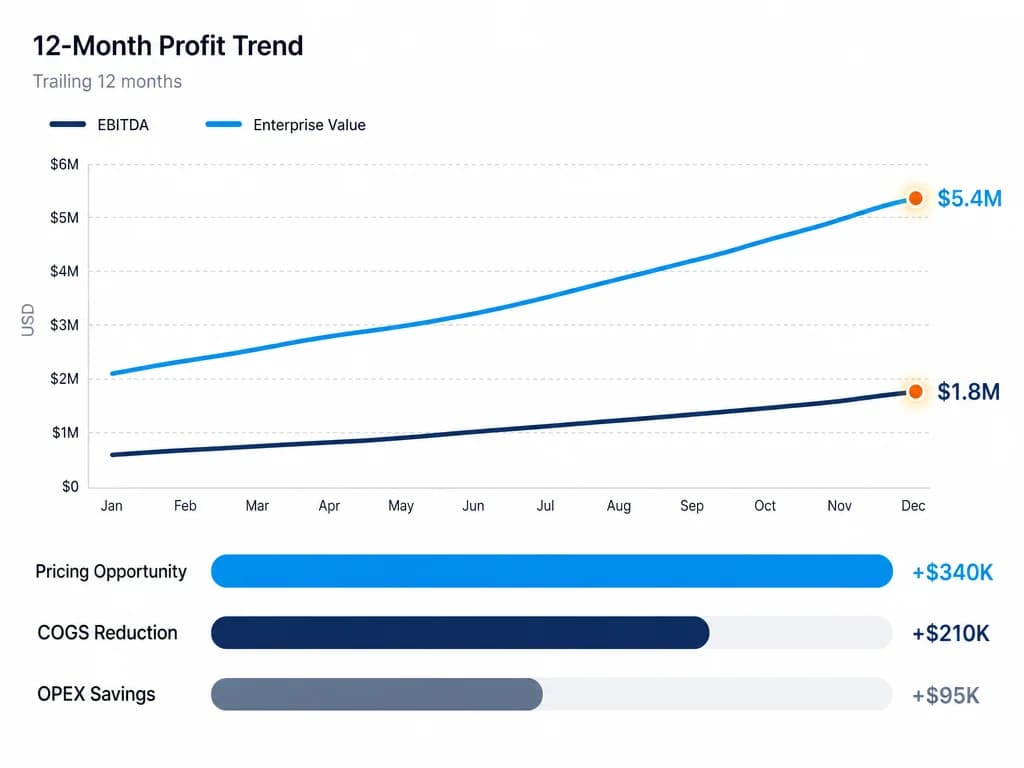
Watch your enterprise value grow — month over month.
Every time you update your numbers, APVAS plots a new data point on your profit trend. EBITDA and EV side by side. You see exactly which lever you pulled and how much it moved the needle.
- EBITDA trend vs Enterprise Value — same chart
- Month-over-month delta on every metric
- AI names the single biggest untapped lever each period
- Industry benchmark overlay so you know where you stand
Built for owners, CFOs, and advisors
Know what your business is worth today — and what it could be worth.
- Understand your EV without hiring a M&A advisor
- Find the 3 changes that move the needle most
- Track whether your decisions are growing value
Board-ready valuation intelligence, updated every month.
- Industry-benchmarked EBITDA margins at a glance
- Clean PDF reports for investor or board updates
- Multiple scenarios in one run — no spreadsheet needed
Run client valuations in minutes, not days.
- Up to 10 companies on Growth, unlimited on Enterprise
- Consistent methodology across all engagements
- AI execution plans as a value-add deliverable
Start free. Scale as you grow.
No credit card required for Free Trial. Annual billing saves 2 months.
Free Trial
One company, no time limit.
- 1 company
- 2 scenarios
- 3 analyses / month
- AI onboarding wizard
- Watermarked reports
Starter
Founders tracking one business.
- 3 companies
- 5 scenarios / company
- Monthly AI insights
- Industry benchmarks
- Full PDF reports
Growth
Advisors and multi-company owners.
- 10 companies
- Unlimited scenarios
- Priority AI plan generation
- PDF + Word export
- Target progress tracking
Enterprise
Advisory firms and PE.
- Unlimited companies
- Real-time EV change alerts
- Custom branding
- Dedicated CSM
Get started today
Your business has a number.
Find it in 20 minutes.
Join founders, CFOs, and M&A advisors who use APVAS to know their enterprise value and grow it — month over month, with AI.
Free forever for one company. Upgrade when you're ready.